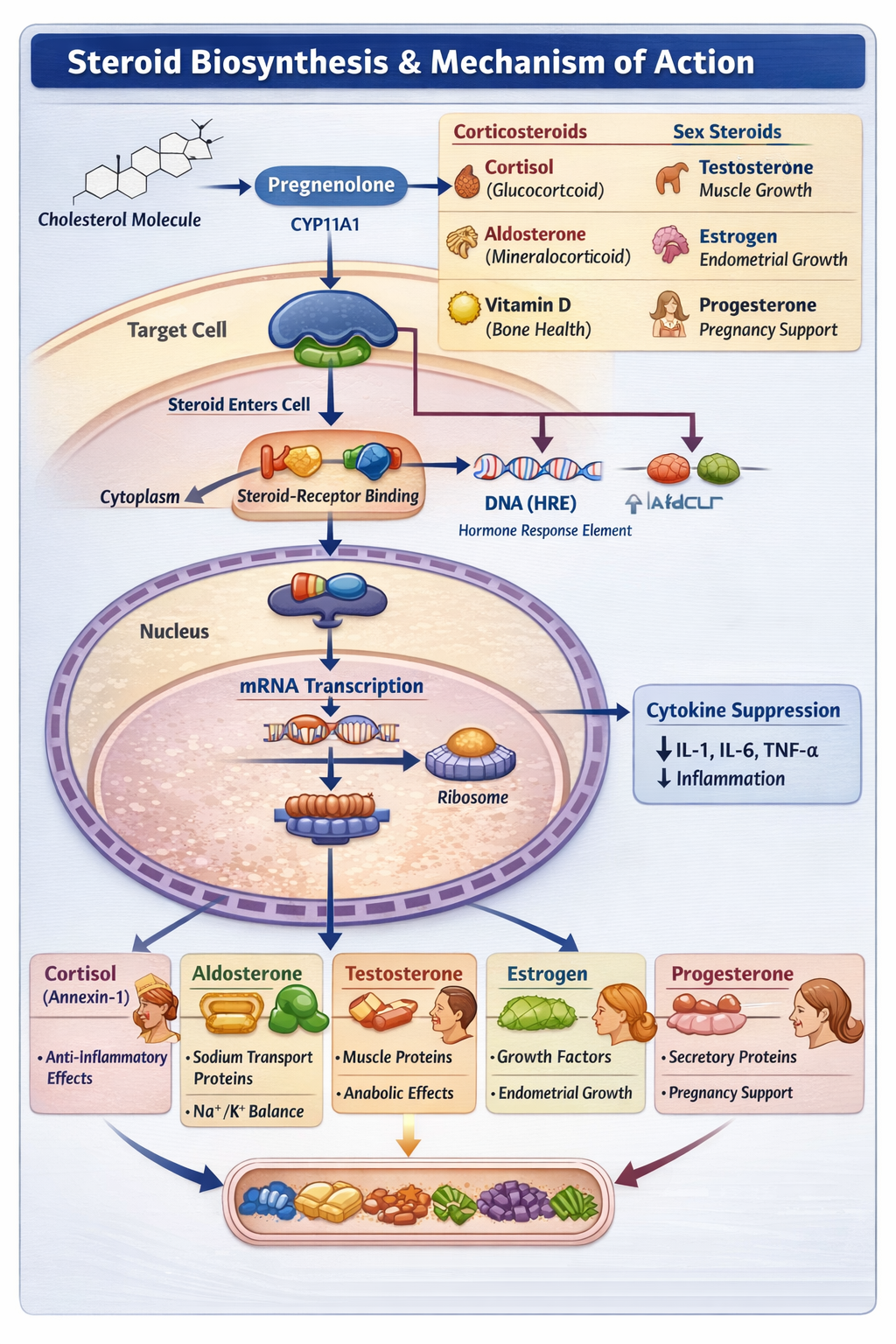
Introduction
Steroids are a large group of biologically active lipid molecules derived from cholesterol. These molecules play critical roles in many physiological processes including metabolism, immune regulation, reproduction, electrolyte balance, and inflammation.
Steroid hormones are unique because they act by directly regulating gene expression inside the cell nucleus. Unlike peptide hormones that bind membrane receptors, steroids easily pass through the cell membrane and interact with intracellular receptors.

This interaction ultimately leads to DNA transcription, mRNA production, and synthesis of specific proteins responsible for the biological effects of steroids.
Understanding steroid hormones is essential for students studying physiology, pharmacology, endocrinology, and clinical medicine.
Basic Chemical Structure of Steroids
All steroid molecules share a common structural framework called the steroid nucleus.
This structure is known as:
Cyclopentanoperhydrophenanthrene
It consists of:
- Three six-carbon rings (Cyclohexane rings A, B, C)
- One five-carbon ring (Cyclopentane ring D)
Total carbon atoms in the basic skeleton = 17 carbons
Additional functional groups attached to this structure determine the specific biological activity of the steroid.
Because steroids are lipid soluble, they can diffuse freely across cell membranes.
Examples of naturally occurring steroids include:
• Cholesterol
• Cortisol
• Aldosterone
• Testosterone
• Estrogen
• Progesterone
• Vitamin D
• Bile acids
Steroid Biosynthesis
All steroid hormones originate from cholesterol, which is the primary precursor.
The process begins inside the mitochondria of steroid-producing cells such as:
- Adrenal cortex cells
- Ovarian cells
- Testicular cells
- Placental cells
The first and most important step in steroid synthesis is conversion of cholesterol into pregnenolone.
Cholesterol → Pregnenolone
Enzyme responsible:
Cholesterol side chain cleavage enzyme (CYP11A1)
Location: Mitochondrial membrane
Pregnenolone then enters different metabolic pathways to form various steroid hormones.
Major Classes of Steroids
Steroids are classified into several functional groups depending on their physiological roles.
1 Corticosteroids
Corticosteroids are produced in the adrenal cortex.
They regulate metabolism, inflammation, and electrolyte balance.
They are divided into two main types.
Glucocorticoids
Example: Cortisol
Main functions:
• Regulation of glucose metabolism
• Anti-inflammatory activity
• Suppression of immune response
• Adaptation to stress
• Protein and fat metabolism
Glucocorticoids are widely used clinically to treat:
- Asthma
- Autoimmune diseases
- Allergic reactions
- Organ transplant rejection
Mineralocorticoids
Example: Aldosterone
Functions:
• Increases sodium reabsorption in kidneys
• Increases potassium excretion
• Maintains blood pressure
• Regulates body fluid balance
Mineralocorticoids mainly act on the distal tubules and collecting ducts of the kidney.
2 Sex Steroids
Sex steroids are produced primarily in the gonads (testes and ovaries).
Androgens
Example: Testosterone
Functions:
• Development of male reproductive organs
• Muscle growth
• Bone development
• Male secondary sexual characteristics
Estrogens
Examples:
• Estradiol
• Estrone
• Estriol
Functions:
• Regulation of female reproductive cycle
• Endometrial growth
• Bone metabolism
• Cardiovascular protection
Progesterone
Functions:
• Preparation of uterus for implantation
• Maintenance of pregnancy
• Regulation of menstrual cycle
3 Anabolic Steroids
Anabolic steroids are synthetic derivatives of testosterone.
They stimulate protein synthesis and muscle growth.
Medical uses include:
• Muscle wasting diseases
• Severe burns
• Delayed puberty
However misuse can lead to serious complications.
4 Vitamin D (Secosteroid )
Vitamin D is considered a steroid derivative because it originates from cholesterol.
Functions:
• Calcium absorption in intestine
• Bone mineralization
• Immune system regulation
5 Bile Acids
Bile acids are steroid derivatives produced in the liver.
Functions:
• Digestion of dietary fats
• Absorption of fat-soluble vitamins (A, D, E, K)
Examples include:
• Cholic acid
• Chenodeoxycholic acid
Mechanism of Action of Steroid Hormones
Steroid hormones act primarily through genomic mechanisms involving DNA transcription.
The process occurs in several steps.
Step 1 Steroid Diffusion into Cell
Because steroids are lipid-soluble molecules, they pass easily through the phospholipid cell membrane by simple diffusion.
No membrane receptor is required.
Step 2 Binding to Intracellular Receptor
Inside the cytoplasm, steroid hormones bind to specific intracellular receptors such as:
• Glucocorticoid receptor
• Androgen receptor
• Estrogen receptor
• Progesterone receptor
• Mineralocorticoid receptor
In inactive form, these receptors are attached to heat shock proteins (HSPs).
Step 3 Receptor Activation
When the steroid binds the receptor:
• Heat shock proteins detach
• Receptor changes shape
• Steroid-receptor complex forms
This activated complex becomes capable of regulating gene expression.
Step 4 Nuclear Translocation
The activated steroid-receptor complex enters the cell nucleus.
Step 5 Binding to DNA
Inside the nucleus the complex binds specific DNA sequences called:
Hormone Response Elements (HREs)
Examples include:
GRE – Glucocorticoid Response Element
ARE – Androgen Response Element
ERE – Estrogen Response Element
Binding to these regions controls transcription of target genes.
Step 6 mRNA Transcription
After DNA binding, the complex recruits RNA Polymerase II, which transcribes DNA into messenger RNA (mRNA).
mRNA acts as a genetic messenger that carries instructions from DNA to the cytoplasm.
Step 7 Protein Synthesis
mRNA travels to ribosomes, where translation occurs.
Ribosomes read the mRNA code and synthesize specific proteins responsible for the physiological effects of steroids.
Important Proteins Produced by Steroid Hormones
Different steroids stimulate production of different proteins.
Examples include:
Cortisol
• Annexin-1 (Lipocortin)
• IκB inhibitory proteins
These proteins suppress inflammatory pathways.
Aldosterone
Produces proteins involved in sodium transport:
• ENaC sodium channels
• Na⁺/K⁺ ATPase pumps
These increase sodium reabsorption in kidneys.
Testosterone
Stimulates production of:
• Muscle structural proteins
• Enzymes involved in anabolic metabolism
Estrogen
Stimulates:
• Growth factors for uterus
• Bone-forming proteins
Cytokines and Steroid Hormones
Cytokines are small signaling proteins produced by immune cells.
They regulate inflammation and immune responses.
Examples include:
• Interleukin-1 (IL-1)
• Interleukin-2 (IL-2)
• Interleukin-6 (IL-6)
• Tumor Necrosis Factor-alpha (TNF-α)
Glucocorticoids suppress inflammation by inhibiting transcription factors such as:
• NF-κB
• AP-1
This inhibition reduces production of pro-inflammatory cytokines.
That is why glucocorticoids are powerful anti-inflammatory drugs.
Time Required for Steroid Action
Because steroids act through gene expression, their effects are not immediate.
Typical timeline:
Cell entry → minutes
DNA transcription → 30-60 minutes
mRNA translation → 2-6 hours
Physiological effect → several hours to days
Clinical Importance of Steroids
Steroids are widely used in medicine for treatment of many diseases.
Examples include:
• Asthma
• Rheumatoid arthritis
• Allergic reactions
• Autoimmune disorders
• Organ transplant rejection
• Hormone replacement therapy
However long-term steroid therapy can cause side effects such as:
• Immunosuppression
• Osteoporosis
• Hyperglycemia
• Hypertension
• Adrenal suppression
Conclusion
Steroid hormones are cholesterol-derived molecules that regulate a wide range of physiological functions through gene transcription and protein synthesis.
Their ability to control DNA activity makes them extremely powerful regulators of metabolism, immune response, reproduction, and electrolyte balance.
Understanding steroid structure, biosynthesis, and mechanism of action is fundamental for medical students studying pharmacology, physiology, and clinical medicine.
Copyright Notice
© 2026 Amina Rehman
All Rights Reserved – aminarehman.com
This article is original educational content created by Amina Rehman for medical learning purposes.
No part of this publication may be copied, reproduced, or redistributed without proper credit to the author.

Leave a Reply