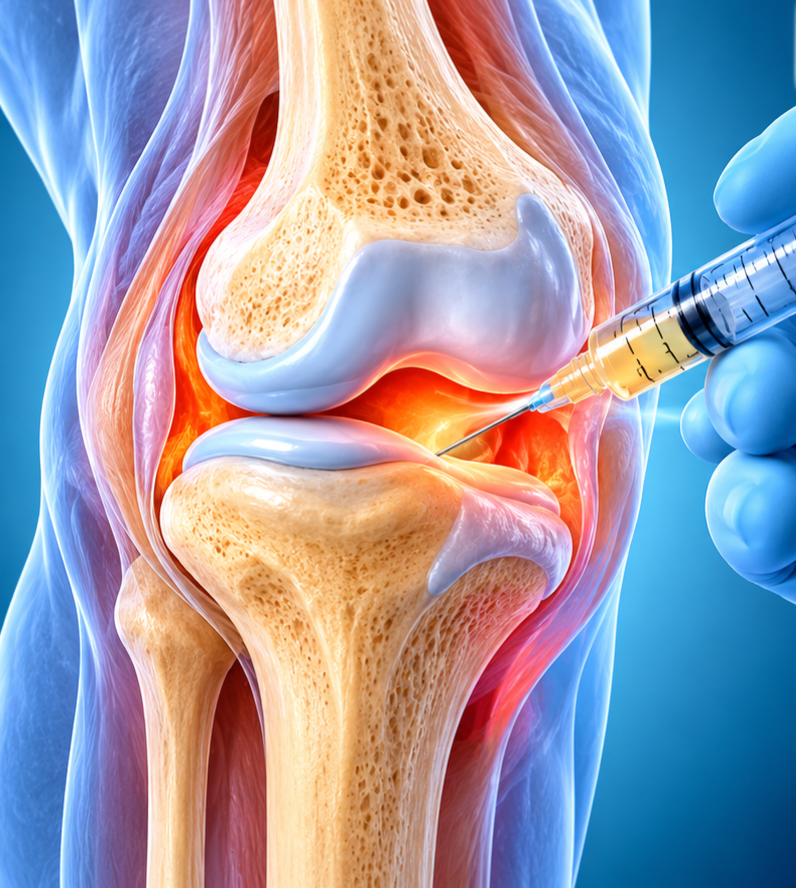
Corticosteroid injections are commonly used in orthopedic practice to manage selected inflammatory joint conditions. One such medication is Kenacort A, which contains triamcinolone acetonide, a synthetic glucocorticoid.
When administered through an intra articular injection, the medication is delivered into the joint space. It acts on local inflammatory pathways, particularly those involving the synovial membrane and inflammatory cells.
But how does a corticosteroid reduce joint pain? Does it repair cartilage? How does it affect inflammatory chemicals at the cellular level?
To understand these questions, it is important to explore the pharmacology of triamcinolone acetonide and the pathophysiology of joint inflammation.
The central concept: Kenacort-A suppresses inflammatory activity. It can reduce pain and swelling, but it does not regenerate damaged cartilage or reverse the structural changes of osteoarthritis.

1. What Is Kenacort A?
Kenacort A contains triamcinolone acetonide, a synthetic glucocorticoid corticosteroid.
Glucocorticoids are medications that regulate inflammation, immune activity, and several metabolic processes.
Drug classification
Property Description Generic name Triamcinolone acetonide Brand Kenacort A Drug class Corticosteroid Subclass Glucocorticoid Main action Anti inflammatory and immunosuppressive Formulation Depot suspension Strength Verify the concentration on the actual product vial
Triamcinolone acetonide is poorly soluble in water. In depot formulations, it is present as small suspended particles that gradually dissolve after administration.
This formulation allows prolonged local drug availability compared with a readily water soluble preparation.
Important: Different triamcinolone products can have different formulations, excipients, concentrations, and approved routes. Always check the exact Kenacort-A package insert used in your country.
2. Pharmacological Classification and Formulation
Kenacort A belongs to the glucocorticoid group.
Its main pharmacological effects include:
- Suppression of inflammatory responses.
- Reduction in inflammatory cytokine production.
- Decreased inflammatory mediator synthesis.
- Reduction of immune cell activity.
- Decreased local inflammatory swelling.
Why is it called a depot corticosteroid?
A depot formulation contains drug particles that dissolve gradually.
After an intra articular injection:
- The suspension is introduced into the joint.
- Drug particles remain within the local joint environment.
- Triamcinolone gradually becomes available as particles dissolve.
- The active drug interacts with cells and glucocorticoid receptors.
- Some medication is eventually absorbed into the systemic circulation.
The duration of symptom relief varies according to the condition, joint, formulation, and individual response. It should not be assumed that every patient will experience the same duration of benefit.
3. Pharmacokinetics and Local Drug Action
Pharmacokinetics describes what the body does to a medication.
It includes four major processes: absorption, distribution, metabolism, and elimination.
Absorption
After intra articular administration, triamcinolone is absorbed gradually from the joint.
Some of the medication can enter the systemic circulation. Therefore, local corticosteroid injections can still produce systemic effects.
Distribution
The medication is distributed within the joint environment and reaches local tissues and cells.
Its main therapeutic objective is to suppress inflammation in the treated area.
Metabolism
Triamcinolone undergoes metabolism mainly in the liver after systemic absorption.
Elimination
Metabolites and drug related substances are eliminated through the body’s normal clearance pathways.
Clinical point: Intra articular administration is intended to produce a local therapeutic effect, but it does not mean that the medication stays entirely inside the joint.
4. Glucocorticoid Receptor: The Cellular Mechanism
This is the most important part of understanding how Kenacort A works.
Triamcinolone does not simply numb the joint or mechanically lubricate it. It changes inflammatory activity inside cells.
Step 1: Entry into the cell
Triamcinolone is sufficiently lipid soluble to cross the cell membrane.
It enters cells in the synovial environment and other local tissues.
Step 2: Binding to the glucocorticoid receptor
Inside the cell, triamcinolone binds to an intracellular glucocorticoid receptor.
The receptor is normally associated with regulatory proteins that maintain it in an inactive state.
When the medication binds, the receptor changes its configuration and becomes activated.
Step 3: Movement into the nucleus
The activated drug-receptor complex moves into the cell nucleus.
The nucleus contains DNA, which controls the production of proteins.
Step 4: Regulation of gene expression
The activated receptor influences gene transcription.
It increases the expression of some anti inflammatory proteins and suppresses the expression of several inflammatory proteins.
This process is called genomic glucocorticoid action.
Step 5: Reduction of inflammation
The final result is reduced production of inflammatory cytokines, prostaglandins, and other inflammatory mediators.
Consequently, the inflammatory response becomes less intense.
Remember: The glucocorticoid receptor is the key link between triamcinolone administration and its anti inflammatory effects.
5. Pathophysiology of Joint Inflammation
To understand why Kenacort A works, we first need to understand what happens inside an inflamed joint.
Normal anatomy of a synovial joint
A typical synovial joint contains several important structures.
Articular cartilage: A smooth protective layer covering the ends of bones. It reduces friction and distributes mechanical loads.
Synovial membrane: A thin tissue lining the inner surface of the joint capsule, except over the articular cartilage. It helps regulate synovial fluid.
Synovial fluid: A lubricating fluid that reduces friction and helps nourish the articular cartilage.
Joint capsule: A fibrous structure surrounding and stabilizing the joint.
Subchondral bone: The bone located immediately beneath the articular cartilage.
What happens during inflammation?
Joint inflammation can occur in rheumatoid arthritis, gout, and other inflammatory conditions. Osteoarthritis can also involve inflammation of the synovial membrane.
The process can be understood in six stages.
Stage 1: Joint irritation or tissue damage
Mechanical stress, cartilage breakdown, crystal deposition, or autoimmune activity can activate cells inside the joint.
Stage 2: Activation of inflammatory cells
Synovial cells and immune cells become activated and release inflammatory mediators.
Stage 3: Cytokine release
Inflammatory chemicals such as:
- Interleukin-1 (IL-1)
- Interleukin-6 (IL-6)
- Tumor necrosis factor-alpha (TNF-α)
increase inflammatory signalling.
Stage 4: Prostaglandin production
The cyclooxygenase pathway helps convert arachidonic acid into prostaglandins.
Prostaglandin E2 (PGE2) contributes to pain sensitization and inflammation.
Stage 5: Synovial swelling and effusion
Inflammation increases blood-vessel permeability.
Fluid and inflammatory cells accumulate within the joint, potentially causing:
- Joint swelling
- Effusion
- Warmth
- Tenderness
- Pain
- Stiffness
- Reduced range of motion
Stage 6: Pain receptor sensitization
Inflammatory mediators make local pain receptors more sensitive.
Even normal movement may become painful.
6. How Does Kenacort A Suppress Inflammation?
Triamcinolone reduces inflammation through several connected molecular pathways.
A. Inhibition of the phospholipase A2 pathway
Cell membranes contain phospholipids.
An enzyme called phospholipase A2 (PLA2) helps release arachidonic acid from these membrane phospholipids.
Arachidonic acid is a starting material for producing inflammatory mediators.
Glucocorticoids increase the activity of anti-inflammatory proteins such as annexin A1, which help inhibit this pathway.
As a result:
- Less arachidonic acid is released.
- Prostaglandin production decreases.
- Leukotriene production decreases.
- Inflammatory signalling is reduced.
B. Reduction of COX-2 activity
Cyclooxygenase-2 (COX-2) is an enzyme involved in producing prostaglandins during inflammation.
Triamcinolone suppresses the expression of COX-2 and other inflammatory genes.
This helps reduce prostaglandin production and inflammatory pain.
C. Suppression of NF-κB and AP-1
NF-κB and AP-1 are transcription factors involved in controlling inflammatory gene expression.
They help activate genes responsible for producing cytokines and other inflammatory substances.
The activated glucocorticoid receptor interferes with these signalling pathways.
Consequently, the production of several inflammatory mediators decreases.
D. Reduction of inflammatory cytokines
Triamcinolone reduces the production and activity of inflammatory cytokines, including IL-1 and TNF-α.
This helps reduce inflammatory activity in the synovial environment.
7. How Does Kenacort A Work in Osteoarthritis?
Osteoarthritis (OA) is not simply a disease of cartilage. It is a whole joint disorder involving cartilage, subchondral bone, synovium, and surrounding structures.
Why does cartilage become thin?
Healthy cartilage is maintained by a balance between tissue breakdown and repair.
In osteoarthritis, this balance becomes disturbed.
Mechanical stress and biochemical changes activate cartilage cells called chondrocytes.
These cells produce enzymes, including:
- Matrix metalloproteinases (MMPs)
- Aggrecanases, such as ADAMTS enzymes
These enzymes break down important cartilage components, including:
- Type II collagen
- Aggrecan
- Other extracellular matrix proteins
As cartilage breakdown progresses, the protective cartilage layer becomes thinner.
Why does the joint space become narrow?
Cartilage does not normally appear directly on a plain X ray.
However, when cartilage becomes thinner, the distance between the adjacent bones decreases.
This is called joint-space narrowing.
It is an indirect radiographic sign of cartilage loss.
Where does Kenacort A work?
Kenacort-A mainly reduces inflammatory activity in the synovial environment.
In osteoarthritis, synovial inflammation can contribute to pain and swelling.
By suppressing inflammatory mediators, triamcinolone may reduce:
- Synovitis
- Joint effusion
- Inflammatory pain
- Stiffness associated with inflammation
Important distinction: Kenacort A does not rebuild cartilage, reverse joint-space narrowing, or cure osteoarthritis. It is used for symptom control in selected patients.
8. Clinical Uses of Intra-Articular Triamcinolone
Depending on the specific formulation, approved product information, and clinical assessment, intra-articular triamcinolone may be used as adjunctive short term treatment for selected inflammatory joint conditions.
Examples include:
- Rheumatoid arthritis affecting a joint.
- Acute gouty arthritis.
- Synovitis associated with osteoarthritis.
- Selected inflammatory joint exacerbations.
A corticosteroid injection is not appropriate for every type of joint pain.
The underlying diagnosis, contraindications, infection risk, and treatment goals must be assessed before the procedure.
9. Adverse Effects and Complications
Although intra-articular administration aims to produce a local effect, complications can occur.
Local complications
- Post-injection flare: temporary worsening of pain.
- Joint infection, including septic arthritis.
- Local skin depigmentation.
- Subcutaneous fat atrophy.
- Local tissue irritation.
- Potential adverse effects on joint tissues, particularly with repeated exposure.
Systemic complications
Some medication may enter the bloodstream and produce systemic corticosteroid effects.
These may include:
- Temporary increase in blood glucose.
- Facial flushing.
- Sleep or mood changes.
- Temporary suppression of the hypothalamic-pituitary-adrenal (HPA) axis.
- Allergic reactions, rarely including severe reactions.
Repeated injections and cumulative corticosteroid exposure require particular attention.
10. Nursing Considerations and Injection Safety
Nurses involved in orthopedic care should understand the medication, formulation, patient assessment, and possible complications.
After the procedure
- Observe the patient according to clinic policy.
- Document the medication, strength, dose, route, site, and batch number where required.
- Record the patient’s response and any immediate adverse effects.
- Explain warning signs that require medical review.
Important safety warning
A suspected infected joint must not be treated with an intra-articular corticosteroid injection until infection has been appropriately excluded and managed.
A sudden increase in pain, swelling, fever, malaise, or worsening restriction of movement after injection requires urgent assessment for possible septic arthritis.
The exact Kenacort A product label must be checked because formulations and approved routes differ between products and countries.
Never administer a depot suspension intravenously.
11. What Kenacort A Does and Does Not Do
What it does What it does not do Reduces inflammation Does not regenerate cartilage Suppresses inflammatory cytokines Does not rebuild damaged bone Reduces synovitis Does not repair a torn meniscus May reduce joint swelling Does not permanently cure osteoarthritis May improve pain and movement Does not reverse joint-space narrowing
- Kenacort A contains triamcinolone acetonide, a synthetic glucocorticoid.
- It acts through intracellular glucocorticoid receptors.
- The activated receptor changes inflammatory gene expression.
- It suppresses pathways involving NF-κB, AP-1, cytokines, and inflammatory mediators.
- It reduces synovial inflammation and may improve pain and swelling.
- Intra articular administration can still produce systemic effects.
- It does not regenerate cartilage or reverse osteoarthritis.
- Correct patient selection, product verification, and aseptic technique are essential.
Medical Disclaimer
This article is intended for medical and healthcare education. It does not replace professional medical assessment, the manufacturer’s prescribing information, or local clinical protocols. Medication selection, dose, and administration must be determined by an appropriately qualified clinician.
© aminarehman.com. All rights reserved.


Leave a Reply