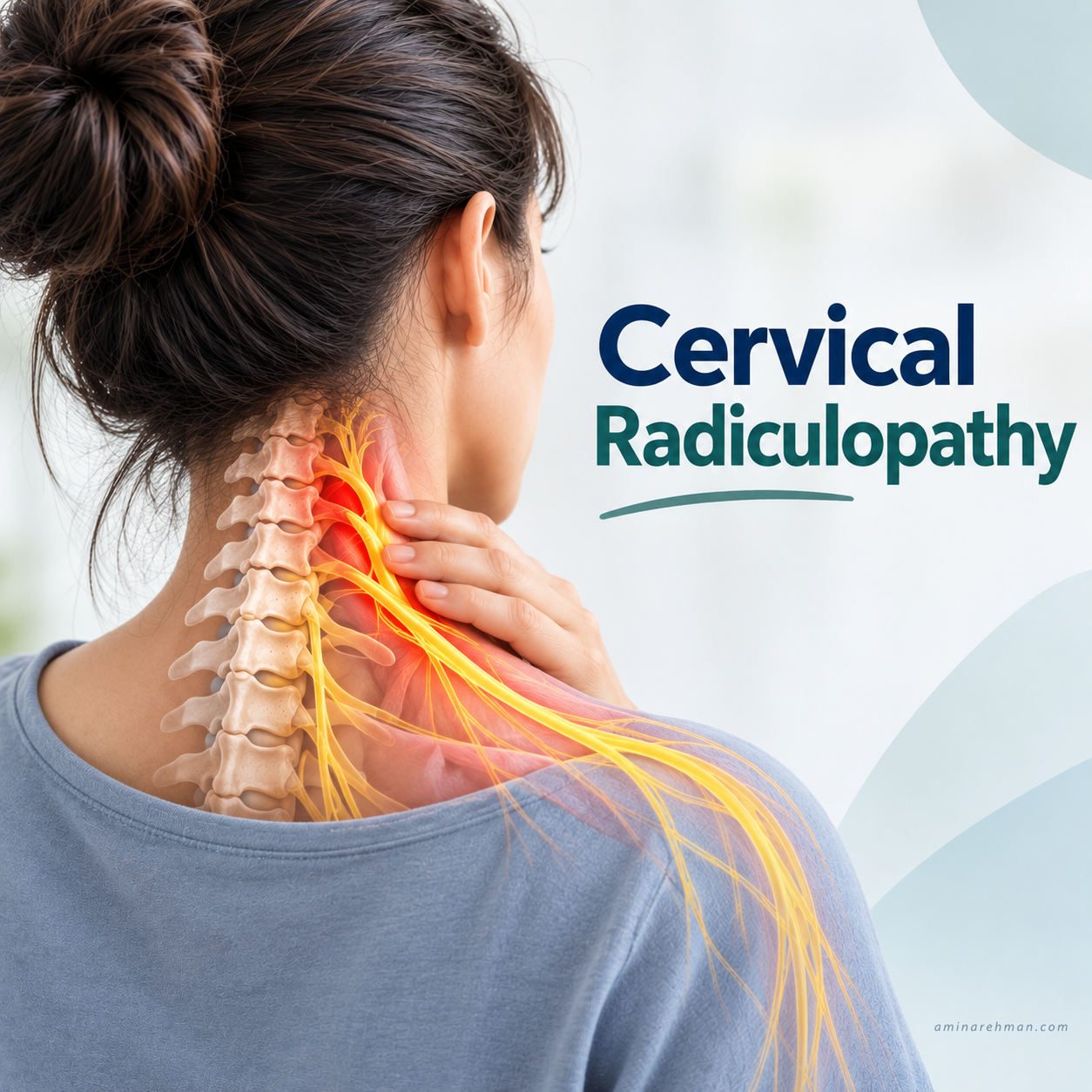
Cervical radiculopathy is a condition in which a nerve root in the neck becomes compressed, irritated, or inflamed. Because the cervical nerves supply the shoulder, arm, and hand, a problem in the neck can cause symptoms far beyond the neck itself.
Patients may experience neck pain, radiating arm pain, numbness, tingling, muscle weakness, or changes in reflexes.
A common cause is a herniated cervical disc, although age related changes such as bone spurs and narrowing of the nerve passageways can also compress a nerve root.
What Is Cervical Radiculopathy?
The term radiculopathy refers to dysfunction of a spinal nerve root.
The cervical spine contains seven vertebrae, from C1 through C7. Between most of these vertebrae are intervertebral discs, which help absorb shock and allow movement.
Cervical nerve roots leave the spinal cord through openings called the intervertebral foramina. These nerves contribute to the network that supplies the shoulder, arm, and hand.
When a nerve root becomes compressed or inflamed, the signals traveling through that nerve can become abnormal.
This can produce:
- Neck pain
- Radiating arm pain
- Tingling or pins-and-needles sensations
- Numbness
- Muscle weakness
- Reduced reflexes
- Difficulty with certain arm or hand movements
How Does Cervical Radiculopathy Develop?
Cervical radiculopathy usually develops when something reduces the space available for a cervical nerve root.
The problem can develop gradually because of degenerative changes, or it can occur more suddenly after a disc injury.
The basic process is:
Disc degeneration or injury
↓
Disc bulging or herniation / bone-spur formation
↓
Nerve-root compression
↓
Mechanical irritation and inflammation
↓
Abnormal nerve conduction
↓
Pain, numbness, tingling, or weakness
The symptoms depend on which cervical nerve root is affected and how severe the compression is.

What Causes Cervical Radiculopathy?
Several conditions can cause cervical nerve root compression.
1. Cervical Disc Herniation
An intervertebral disc consists of a softer inner portion surrounded by a stronger outer ring.
With aging, injury, or degeneration, the outer portion can weaken or tear. The inner disc material may then protrude toward a nerve root.
This is called a herniated cervical disc.
The sequence is:
Disc weakening → disc herniation → nerve-root irritation → inflammation → neurological symptoms
A herniated disc can sometimes produce symptoms suddenly, particularly following an injury or strenuous movement.
2. Cervical Spondylosis
Cervical spondylosis refers to age-related degenerative changes in the neck.
Over time:
- Intervertebral discs may lose water and height.
- Joints may develop degenerative changes.
- Bone spurs (osteophytes) may form.
- The spaces through which nerves travel may become narrower.
These changes can eventually cause nerve root compression.
3. Foraminal Stenosis
The intervertebral foramen is the opening through which a spinal nerve exits the spine.
If this opening becomes narrowed because of disc degeneration, bone spurs, or other structural changes, the nerve root can become compressed.
This is called foraminal stenosis.
4. Cervical Spine Injury
Trauma to the neck can cause:
- Disc injury
- Swelling
- Vertebral injury
- Ligament injury
- Increased pressure around a nerve root
Anyone who develops numbness, weakness, or severe radiating pain after significant neck trauma should receive prompt medical evaluation.
How Does Nerve Compression Cause Symptoms?
A spinal nerve carries different types of information between the brain, spinal cord, muscles, and skin.
Sensory Nerve Fibers
Sensory fibers carry information from the body toward the spinal cord and brain.
When these fibers become irritated or compressed, they can produce:
Pain → tingling → altered sensation → numbness
Motor Nerve Fibers
Motor fibers carry signals from the nervous system to the muscles.
Significant nerve-root compression can interfere with these signals and cause:
Reduced motor signaling → muscle weakness
Reflex Pathways
Certain cervical nerve roots contribute to deep tendon reflexes.
Nerve root dysfunction can therefore cause:
Reduced or abnormal reflexes
Why Does a Pinched Nerve in the Neck Cause Arm Pain?
One of the most characteristic symptoms of cervical radiculopathy is radiating arm pain.
Although the compression occurs in the neck, the affected nerve travels toward the shoulder, arm, forearm, and hand.
The brain can therefore perceive pain along the distribution of the affected nerve.
For example:
Neck → Shoulder → Arm → Forearm → Hand
This type of pain is known as radicular pain.
Cervical Radiculopathy Symptoms
The symptoms depend on the affected cervical nerve root.
Common symptoms include:
Neck Pain
Pain may be localized to the neck or associated with neck stiffness.
Radiating Arm Pain
Pain may travel from the neck into the:
- Shoulder
- Upper arm
- Forearm
- Hand
- Fingers
Tingling
Patients may describe:
- Pins and needles
- Burning
- Electric shock sensations
- Abnormal skin sensations
Numbness
Reduced sensation can occur in a specific area of the arm or hand.
Muscle Weakness
Significant nerve-root dysfunction can cause muscle weakness.
Patients may notice:
- Difficulty lifting the arm
- Weak grip
- Difficulty extending the wrist
- Difficulty pushing or pulling
- Dropping objects
Reflex Changes
A neurological examination may demonstrate reduced deep tendon reflexes associated with the affected nerve root.
Cervical Nerve Roots: C5, C6, C7, and C8
The clinical pattern can vary between individuals, but these are common patterns:Nerve RootCommon Sensory AreaPossible WeaknessReflexC5 Lateral upper arm Shoulder abduction Biceps contribution C6 Thumb and index-finger region Elbow flexion / wrist extension Brachioradialis C7 Middle finger region Elbow/finger extension Triceps C8 Ring and little fingers Finger flexion / grip Variable
These patterns are not absolute because adjacent nerve roots can overlap.
C5 Radiculopathy
C5 nerve root involvement may cause symptoms around the:
- Shoulder
- Lateral upper arm
Possible weakness can involve shoulder abduction.
C6 Radiculopathy
C6 radiculopathy commonly produces symptoms extending toward:
- Lateral forearm
- Thumb
- Index finger region
Possible weakness may involve:
- Elbow flexion
- Wrist extension
C7 Radiculopathy
C7 radiculopathy is a commonly encountered cervical nerve root problem.
Symptoms may extend toward:
- Back of the arm
- Forearm
- Middle finger
Possible weakness can involve:
- Elbow extension
- Finger extension
The triceps reflex may be reduced.
C8 Radiculopathy
C8 radiculopathy often involves the:
- Medial forearm
- Ring finger
- Little finger
Possible weakness can involve:
- Finger flexion
- Grip strength
- Fine hand movements
Cervical Radiculopathy vs Cervical Myelopathy
These conditions are important to distinguish.
Cervical Radiculopathy
Primary problem: Nerve root
Typical symptoms include:
- Radiating arm pain
- Tingling
- Numbness
- Focal muscle weakness
- Reduced reflexes
Cervical Myelopathy
Primary problem: Spinal cord
Possible symptoms include:
- Hand clumsiness
- Difficulty with fine motor tasks
- Balance problems
- Difficulty walking
- Leg stiffness or weakness
- Increased reflexes
- Abnormal neurological reflexes
- In severe cases, bowel or bladder dysfunction
Progressive neurological symptoms suggesting spinal cord involvement require prompt medical evaluation.
How Is Cervical Radiculopathy Diagnosed?
Diagnosis begins with a detailed medical history and neurological examination.
The healthcare professional may assess:
- Pain location
- Muscle strength
- Sensation
- Reflexes
- Neck movement
- Arm and hand function
- Signs of spinal cord involvement
Neurological Examination for Cervical Radiculopathy
1. Motor Examination
Muscle strength may be tested in the:
- Shoulder
- Elbow
- Wrist
- Fingers
- Hand
The clinician compares both sides.
2. Sensory Examination
The clinician may assess:
- Light touch
- Pinprick
- Other sensory functions
The distribution of sensory changes can help identify the affected nerve root.
3. Reflex Examination
Common reflexes include:
- Biceps reflex
- Brachioradialis reflex
- Triceps reflex
Changes in reflexes can provide additional evidence of nerve root dysfunction.
MRI for Cervical Radiculopathy
Magnetic resonance imaging (MRI) provides detailed images of:
- Intervertebral discs
- Nerve roots
- Spinal cord
- Spinal canal
- Foraminal narrowing
- Disc herniation
- Degenerative changes
MRI is particularly useful when there are significant or progressive neurological deficits, concerning features, or symptoms that persist despite appropriate conservative treatment.
An important point is that an abnormal MRI does not automatically mean surgery is required. Imaging findings should be interpreted together with the patient’s symptoms and neurological examination.
Treatment for Cervical Radiculopathy
Treatment depends on:
- Cause
- Severity
- Duration
- Neurological findings
- Response to initial treatment
Many uncomplicated cases improve with non surgical treatment.
1. Activity Modification
Avoid activities that clearly worsen the symptoms.
However, prolonged bed rest is generally not recommended.
Maintaining appropriate activity can help prevent stiffness and muscle deconditioning.
2. Medications for Cervical Radiculopathy
Depending on the patient’s medical history, a healthcare professional may recommend:
- Paracetamol/acetaminophen
- NSAIDs, such as ibuprofen or naproxen
- Other prescription medications when appropriate
Medication selection should take into account kidney function, gastrointestinal risks, cardiovascular disease, anticoagulant use, allergies, pregnancy, and other medications.
3. Physical Therapy for Cervical Radiculopathy
Physical therapy is an important component of conservative treatment.
A physiotherapist may develop an individualized program including:
- Posture correction
- Cervical mobility exercises
- Strengthening exercises
- Shoulder and upper-back strengthening
- Stretching
- Neural mobility exercises
- Selected traction techniques
The goal is to reduce mechanical stress, improve movement, decrease symptoms, and restore function.
4. Heat and Cold Therapy
Some patients experience temporary relief using:
- Heat therapy
- Cold packs
These treatments may help control discomfort but do not correct the underlying structural problem.
5. Epidural Steroid Injection
For selected patients with persistent radicular pain, a specialist may consider an epidural steroid injection.
The goal is to reduce inflammation around the affected nerve.
It may provide temporary pain relief but does not necessarily remove the underlying disc herniation or bone spur.
6. When Is Surgery Needed for Cervical Radiculopathy?
Cervical radiculopathy does not automatically require surgery.
Surgery may be considered when there is:
- Progressive muscle weakness
- Significant neurological deficit
- Persistent disabling pain despite appropriate conservative treatment
- Significant nerve compression
- Spinal cord compression
- Cervical myelopathy
The fundamental goal of surgery is:
Decompress the affected nerve → restore adequate space → reduce nerve irritation → preserve or improve neurological function.
Common Surgical Treatments
Depending on the cause and location of compression, surgical options may include:
Anterior Cervical Discectomy and Fusion (ACDF)
The surgeon removes the problematic disc or compressive material and stabilizes the affected spinal level.
Cervical Disc Replacement
In selected patients, the damaged disc may be removed and replaced with an artificial disc.
Posterior Cervical Foraminotomy
In appropriate cases, the surgeon enlarges the neural foramen to relieve pressure on the affected nerve root.
The appropriate procedure depends on the patient’s anatomy, symptoms, spinal alignment, affected levels, and cause of nerve compression.
When Is Cervical Radiculopathy an Emergency?
Most cases are not emergencies. However, certain symptoms require urgent medical assessment.
Seek prompt medical attention for:
Rapidly worsening weakness
Difficulty walking or loss of balance
Significant hand clumsiness
Weakness involving multiple limbs
New bowel or bladder dysfunction
Rapidly progressing numbness
Severe neck pain following significant trauma
Fever or systemic illness with severe neck pain
These symptoms may indicate spinal cord compression or another serious condition.
Cervical Radiculopathy: The Complete Process
The condition can be summarized as:
Disc degeneration or injury
↓
Disc herniation / bone-spur formation
↓
Narrowing of the nerve passageway
↓
Cervical nerve-root compression
↓
Mechanical irritation + inflammation
↓
Abnormal nerve conduction
↓
Pain + tingling + numbness
↓
Motor dysfunction
↓
Muscle weakness
↓
Possible reflex abnormalities
↓
Difficulty with normal arm or hand function
© 2026 Amina Rehman. All Rights Reserved.


Leave a Reply